If you have spoken to anyone about your website in the past year, you have probably been offered SEO, and increasingly AEO and GEO alongside it. Often as three separate services, with three separate prices.
It is worth understanding what these actually refer to before deciding what to pay for. Not least because, as of early 2026, there is no agreed definition separating two of the three.
SEO: the established one
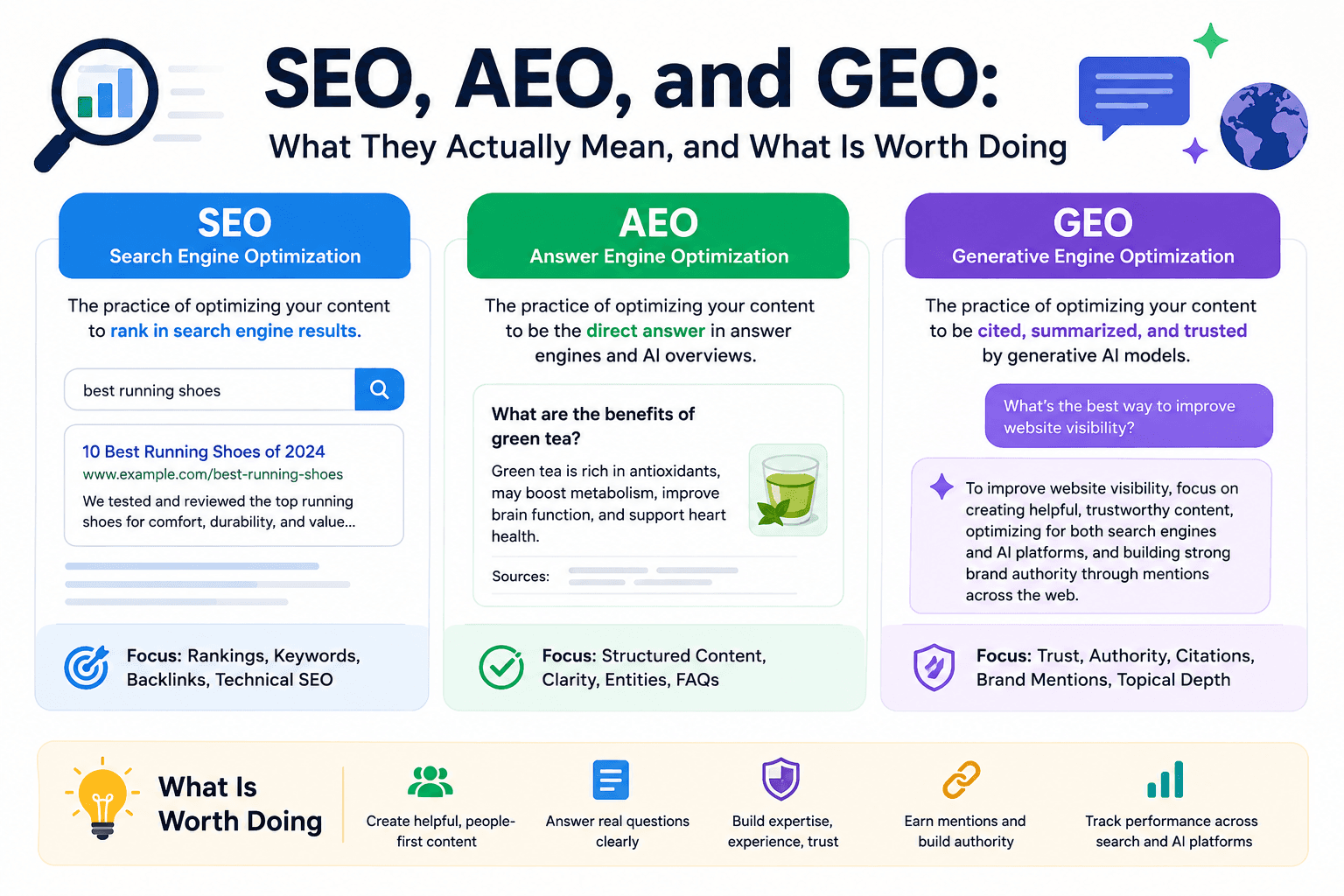
Search Engine Optimization is the practice of getting your pages to rank in search engines like Google and Bing. It has existed for roughly twenty-five years, the mechanics are well understood, and the goal is straightforward: someone searches, your page appears, they click, they arrive on your site.
The work divides into three broad areas. Technical foundations, which means your site loads quickly, works on phones, and can be read by a crawler. Content, meaning pages that genuinely answer what people are searching for. And authority, which mostly means other credible websites linking to yours.
None of that is controversial. It has been the shape of the discipline for a long time.
AEO and GEO: the newer, blurrier ones
Answer Engine Optimization and Generative Engine Optimization both refer to being visible when the answer comes from an AI system rather than a list of links. When someone asks ChatGPT, Perplexity, Claude, or Google's AI summaries a question, and the response mentions your company, that is the outcome both terms describe.
Here is the part vendors rarely mention: there is no settled distinction between them. As of early 2026 no consensus definition separating these terms had been established in the academic literature, and they are frequently used interchangeably in practice. You will also encounter LLMO, AIO, and "AI SEO" describing the same activity.
Some practitioners will tell you AEO is about content structure while GEO is about how AI systems understand your company as an entity. Others say they are two names for identical work. Both positions are argued confidently, often by people selling the service they are defining.
This does not mean the underlying shift is fake. It is real, and it matters. It means the vocabulary is unsettled, and you should be sceptical of anyone selling three distinct services when the industry cannot agree whether two of them are different.
What has actually changed
Strip away the terminology and one thing is genuinely different: a growing share of questions now get answered without anyone visiting a website.
Someone asks an AI assistant which software company to use in their region. The assistant produces an answer drawing on several sources. The person may never see a list of links at all. If your business is not part of what the system draws on, you were not considered, and you will never see it in your analytics because there was no visit to measure.
That is a real change in how being findable works. Under traditional search, ranking well meant traffic. Under AI-mediated answers, being cited may mean influence without a click.
Why this matters for a business website
Three practical reasons.
Buyers research before they contact you. Whether they use Google or an AI assistant, most of the evaluation happens before you know they exist. Being absent from that stage means being absent from the decision.
The channels overlap more than the acronyms suggest. AI systems draw heavily on content that already ranks and sites that are already credible. Work that improves one usually improves the other.
It compounds slowly. Neither search nor AI visibility responds quickly. A site that starts publishing credible content this year is in a materially different position in eighteen months than one that starts then.
What is worth doing
The encouraging part: most of what works is the same for all three, and it is durable rather than faddish.
Make your site readable by machines. Content should be present in the page itself, not assembled by JavaScript after loading. Search engines can usually cope with the latter; many AI crawlers cannot and will simply read nothing. This is a common and invisible failure, and worth checking specifically.
Be specific rather than impressive. "We deliver innovative solutions that drive efficiency at scale" contains no information. An AI system cannot cite it and a buyer learns nothing. "We built a delivery platform that cut delivery costs by 60% by clustering orders into zones" can be cited, remembered, and checked. Specificity is the single largest difference between content that gets used and content that gets skipped.
Answer real questions directly. If people ask what something costs, publish what it costs. If they ask how long a project takes, say so. Pages that answer a question plainly, near the top, in ordinary language, are what both featured snippets and AI answers are assembled from.
Use structured data. Schema markup tells machines what your organisation is, what you sell, and how your pages relate. It is unglamorous, one-time work that helps every system that reads your site.
Build genuine credibility elsewhere. Directory listings, industry associations, press, and content other people choose to reference. This is the slowest part and the hardest to fake, which is exactly why it carries weight.
Publish consistently, at a pace you can sustain. Ten well-constructed pieces outperform a hundred thin ones. Volume for its own sake has little effect on generative systems, and it costs you credibility with human readers too.
What to be sceptical of
Guaranteed rankings or guaranteed AI citations. Nobody controls these systems. Anyone promising a specific position is either misunderstanding the mechanism or hoping you do.
Fast results. A new domain takes months to establish itself regardless of spend. Anything that produces a rapid jump is usually a tactic with a short life and a penalty attached.
Three prices for one discipline. If a proposal separates SEO, AEO, and GEO into distinct line items, ask what specifically differs between them. It is a fair question and the answer is revealing.
Content volume as the strategy. Publishing a hundred articles because someone said AI needs content is the most common and most wasteful response to this shift.
The short version
SEO is established and well defined. AEO and GEO describe a real change in how people find information, using vocabulary the industry has not settled and may never settle.
The work that serves all three is the same work: a site machines can read, content specific enough to be worth citing, direct answers to real questions, structured data, credibility built elsewhere, and consistency over time.
That was good practice before the acronyms existed. It will still be good practice after the next one arrives.